Weight, RFID, infrared or camera: how smart bins sense stock.
Smart bins use four main ways to know what is in a bin. Each measures something different, and only one gives a true part count for loose small parts.
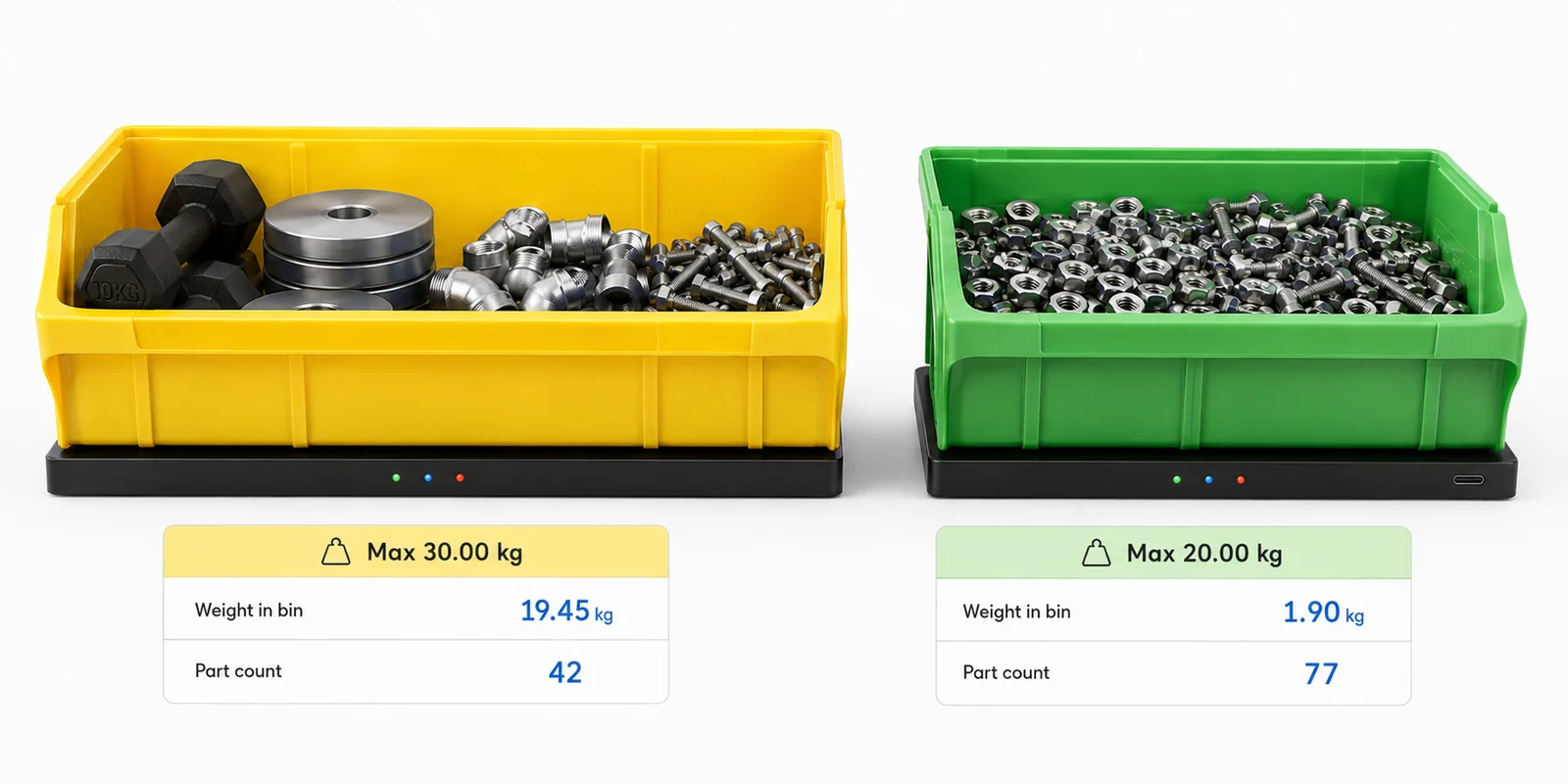
Smart bins use four main sensing methods. Weight sensors count parts by weighing the bin. RFID detects tagged cards or items. Infrared and ultrasonic sensors measure fill level. Cameras photograph the bin. Only weight gives a part count for loose small parts without tagging each item; fill-level and camera methods estimate how full the bin is.
How do the four sensing methods compare?
| Method | What it measures | Part count? | Tags needed? | Good for | Limits |
|---|---|---|---|---|---|
| Weight | Bin weight ÷ weight of one part | Yes | No | Fasteners, fittings, seals, electrical parts | One part type per bin; very light parts need a low-capacity scale |
| RFID | Presence of tagged cards or items | Only for tagged items | Yes | Kanban cards, tools, tagged high-value items | Tagging effort; metal can interfere |
| Infrared / ultrasonic | Distance to the top of the stock | No: % full | No | Bulky items and bulk materials | Uneven piles read inaccurately |
| Camera | Image of the bin | Estimate only | No | Visual check, half-full or empty triggers | Needs line of sight and lighting |
Why does Maxi Bin use weight?
Nothing to tag
Parts go into the bin as delivered. No labels, tags or cards to maintain.
A count, not a guess
You see 237 washers, not 'about half full'.
Works with your bins
Any standard bin on a scale. No line of sight, lighting or special containers needed.
Frequently asked questions
Which sensing method is most accurate for small parts?
Weight. It gives an actual part count for loose parts without tagging them. Fill-level and camera methods estimate how full the bin is rather than counting.
Can weight sensing count a bin of mixed parts?
No. Counting by weight needs one part type per bin, because the count is total weight divided by the weight of one part.
Does RFID work with metal parts?
Metal and liquids can interfere with RFID reads, and loose small parts cannot practically be tagged one by one. RFID works best on cards, totes or individually tagged items.
When is fill-level sensing a better choice?
For bulky items or bulk materials where a percentage-full reading is enough and the items are too large for a bin scale.
Related guides
Not sure which method suits your parts?
Tell us what is in your bins and we will tell you honestly whether weight is the right fit.