Know how many parts are in every bin, in real time.

A scale under each bin counts what is inside and reports stock levels to your screen. No counting, no scanning, no stocktake.

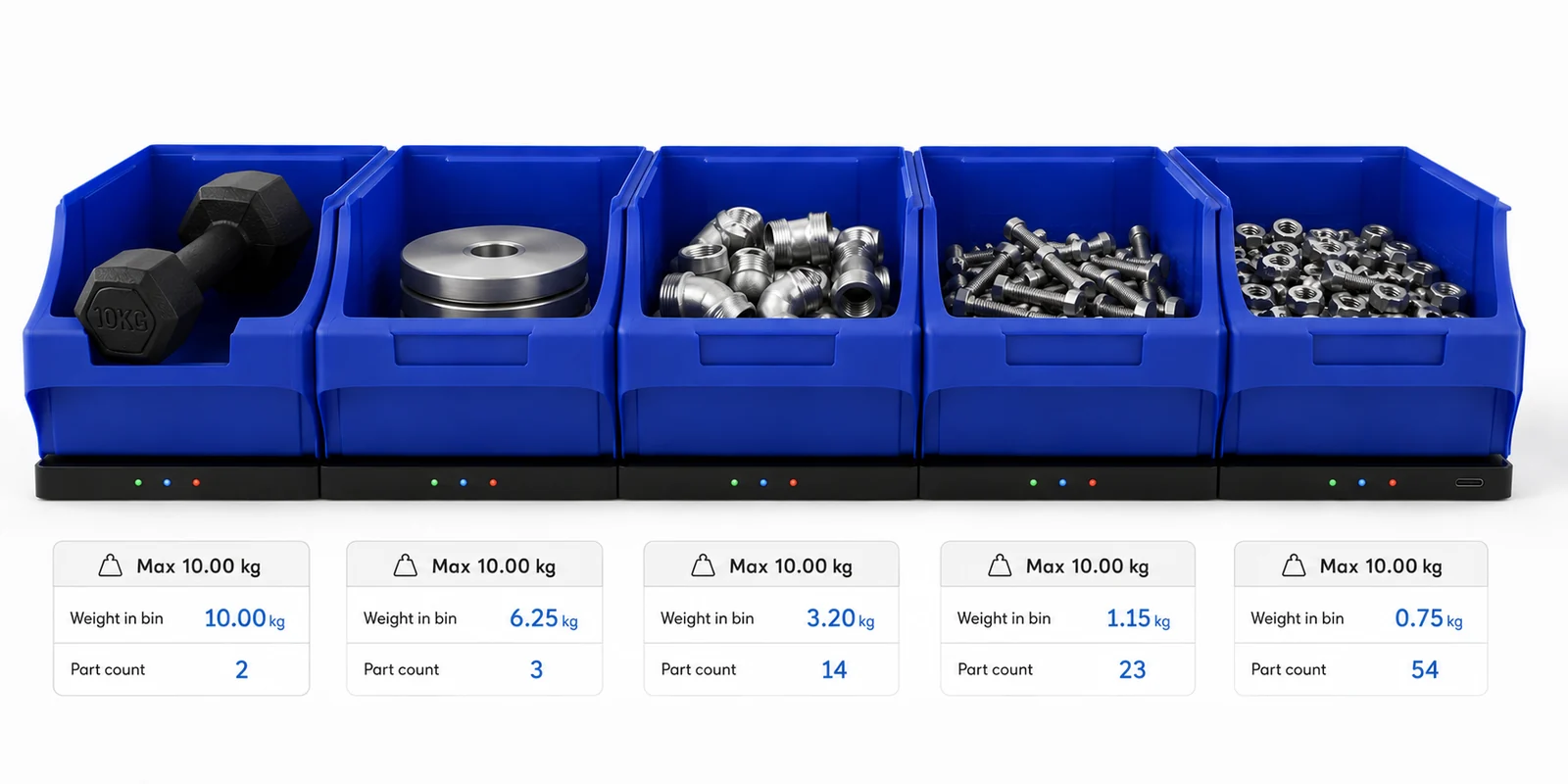
Five bins on scales, each showing weight and part count on screen
What changes

Install the scales. Stop counting.

Stock levels always current

Every bin reports how many parts are inside. The count updates as parts are taken and returned — no manual input needed.

Low bins flagged early

Set a minimum for each bin. When stock drops below it, the bin is flagged and the people who order parts know before the line stops.

No more stocktakes

The count for every bin is always current, so there is nothing to reconcile. The quarterly count that takes two people off the floor goes away.

ERP updated automatically

Bin counts push straight to your inventory system. Stock records stay accurate without anyone re-keying numbers from a clipboard.

How it works

Step 01

Connect the scales together.

Each scale plugs into the next with a short USB-C link along the base. One cable run powers a whole shelf and carries every count back — no wiring per bin.

Power Comms Parts detected
Step 02

Connect the shelf to the Portal.

Run one cable from the end of the chain to the Portal. It powers the scales and collects the count from each bin. One Portal handles up to 127 scales.

1 cable per shelfUp to 127 bins
Step 03

Put it on your network, or on a Display.

Plug the Portal into your network to see stock from any device, or connect a Display to read the bins right at the rack. Use either, or both.

Ethernet or Wi-FiDisplay at the rack
Step 04

Monitor stock levels in the app.

Every bin shows its quantity on hand in one screen. Check what is running low, reorder before it stops the line, and skip the stocktake.

All bins, one screenLow-stock alerts
One bin to the whole store

Start with one shelf. Scale to the full store.

Same scales, same app, same connection. Add bins as you go — there is nothing to reconfigure and no software upgrade when you grow.

127
Bins per portal
1
Cable per shelf
A full storage rack of coloured bins across five shelves, each bin sitting on a scale with lit LED indicators
Five blue bins filled with sorted parts, each on its own scale showing data on screen
The app

Every bin on one screen.

A cloud portal you open in a browser — phone, tablet or desktop. See what is in stock, what is running low, and what needs reordering. Connects straight to your ERP so stock records stay accurate without re-keying.

See it running on your own bins.

Tell us the parts you hold and we will put together a system that fits your store.

The product
01 / The scale

A scale that sits under each bin.

A slim scale slides under any standard storage bin. It counts the parts inside by weight and reports the number to the app — without changing your racking, your bins, or the way the line picks.

18 mm profileFits standard bins
02 / In use

Load the bin as normal.

Parts go in and out the same way they always have. The scale reads the total weight continuously and turns it into a part count — one scale per bin, as many bins as the store needs.

One bin, one scaleContinuous read
03 / Data

Weight and part count, bin by bin.

Set the weight of a single part once. The scale reports how many are inside — from two heavy castings to five hundred washers. Each unit reads independently and reports through a single connection.

2 to 500+ parts1 read / second
04 / Sizes

Sized and rated to your parts.

Choose the footprint to match the bin and the capacity to match the parts, from light fasteners to heavy components. Both size and capacity are built to order.

Any bin sizeLight to heavy parts

Ready to see it on your bins?

Select the scales and accessories you need and we will build a quote around your store.

Technical specifications

The full range, in one matrix.

Platforms are specified by footprint and capacity. Pick the size that matches the bin and the capacity that covers the parts inside — every combination below is a standard build, and anything beyond it is made to order.

Platform matrix — model code / weighing resolution
Footprint 5 kg 10 kg 20 kg 30 kg 50 kg
Compact 210 × 150 mm
MBS-C05±5 g
MBS-C10±10 g
MBS-C20±20 g
MBS-C30±30 g
MBS-C50±50 g
Standard 300 × 200 mm
MBS-S05±5 g
MBS-S10±10 g
MBS-S20±20 g
MBS-S30±30 g
MBS-S50±50 g
Large 420 × 260 mm
MBS-L05±5 g
MBS-L10±10 g
MBS-L20±20 g
MBS-L30±30 g
MBS-L50±50 g
Wide 600 × 230 mm
MBS-W05±5 g
MBS-W10±10 g
MBS-W20±20 g
MBS-W30±30 g
MBS-W50±50 g
Custom Made to order Custom footprint and capacity — contact us with your bin dimensions and part weights

Part-count accuracy depends on the weight of a single part relative to the platform resolution. Heavier parts count reliably on higher-capacity platforms; light parts are best matched to a 5 or 10 kg unit.

Scale specifications All models

  • Profile height: 18 mm
  • Housing: glass-filled nylon deck, powder-coated steel base
  • Indicators: 3 × LED — power (green), comms (blue), parts detected (red)
  • Sample rate: 1 reading / second
  • Connectivity: USB-C (power + data), daisy-chained scale to scale
  • Devices per portal: up to 127
  • Power: 5 V via USB-C, supplied by Portal or Display
  • Ingress protection: IP54
  • Operating temperature: 0 – 50 °C
  • Data output: web app
  • Country of origin: Australia

Portal MBS-PORTAL

  • Network interface for one chain — Ethernet and Wi-Fi
  • Puts live counts on your network and into the app
  • Powers and reads up to 127 scales
  • USB-C downstream to the first scale

Display MBS-DISPLAY

  • 10.1″ touchscreen showing live counts at the rack
  • Drives a chain directly — no separate Portal required
  • Powers and reads up to 127 scales
  • USB-C downstream to the first scale

Every chain needs at least one Portal or one Display. Add a Portal for network and app reporting, a Display for a standalone read on the floor, or both.

Setup options

Two ways to read the chain.

Run the chain onto your network through the Portal, or connect a Display for a standalone read at the bench. Either way, one Portal serves the whole chain.

Diagram of two setups: networked setup with scales connected to a Portal via USB and to a monitor over Ethernet, and local display setup with a Display connected directly to the Portal
StockMonitor

Complete inventory visibility from a browser.

A cloud portal that turns scale readings into a live inventory system. Dashboard, alerts, trends, consignment tracking and ERP connection — all in a browser, nothing to install.

StockMonitor dashboard showing total parts, container status donut, inventory trend chart, low stock table, and recent activity feed
Dashboard — total parts, container status, inventory trend, low-stock items and recent activity at a glance.
Core features

Everything the floor and the office need in one place.

Dashboard

Full picture at a glance

Total parts, number of containers, bins below minimum, offline scales, inventory value and changes today — all on one screen with recent activity.

Inventory

Parts, containers and locations

Browse by part number, description or location. See on-hand quantity, total weight, unit weight, min/max levels, percentage full and status for every container.

Alerts

Know before the line stops

Below-minimum, empty, offline, rapid decrease, unexpected weight change and container-removed alerts. Acknowledge each one so nothing gets missed.

Trends

See how stock moves

Total inventory over time, daily consumption, most-used parts, slow-moving stock and inventory by location — all as charts you can filter by date range.

Activity

Complete audit trail

Chronological log of every replenishment, quantity change, scale disconnect and empty event. Filter by date, part, container, location or customer.

Locations

Grouped by where they sit

Organise containers by physical location. Each location shows its container count, total parts, low-stock items and last activity.

StockMonitor location view showing stock levels table with part numbers, quantities, status and percentage-full bars
Location view

Drill into any warehouse, shelf or customer site.

Filter by status, category or part number. See on-hand quantity, min and max levels, percentage full with a progress bar, and the last time each container was updated — all in one sortable table.

Consignment and billing

Track what your suppliers own and what your customers use.

Consignment

Supplier-owned stock

Current inventory, parts consumed, remaining stock, inventory value, last replenishment and full stock history — by customer or supplier.

Billing

Consumption for any period

Opening quantity, quantity used, closing quantity, unit price and total value. Export to PDF, CSV or direct to your accounting system.

Reports

Ready-made and exportable

Current inventory, low stock, empty containers, inventory by location or customer, consumption history, valuation, movement history and offline scales.

Unique to weight-based monitoring

A complete inventory timeline, not just a snapshot.

Continuous measurement means you can see exactly when stock changed, when containers were replenished, and what the stock level was at any point in time — not just the last time someone scanned a barcode.

ERP connection

Send the counts straight to your ERP.

Bin counts update the same stock records your purchasing already runs on. No double handling, no re-keying, no separate spreadsheet.

If your system is not on the list, the API covers it. Tell us what you run and we will confirm the connection before you order.

Ways to connect MBS-CLOUD

  • Standard connectors for common ERP and inventory systems
  • REST API for counts, minimum levels and container status
  • Webhooks that fire when a container drops below its minimum
  • Scheduled CSV export for reporting and stocktake records
  • Read-only access for suppliers running consignment stock
  • PDF and CSV billing exports by period
Administration

Set it up once, then let it run.

Manage

Parts

Part numbers, descriptions, unit weights, min/max levels and reorder points.

Manage

Containers

Assign parts to containers, set capacity and track by container ID.

Manage

Scales and locations

Map each scale to a container and each container to a physical location.

Manage

Users and notifications

User accounts, access levels, and notification rules for alerts and thresholds.

See it running on your own bins.

Tell us the parts you hold and we will show you the count in the app.

Request a quote

Build your configuration.

Tick the platforms and accessories you need, set quantities, and add your details. We will confirm sizing against your bins and respond with a quote within one business day.

Bin platforms

Size · capacity · qty

Accessories

Required per chain
Portal MBS-PORTAL · network interface
Display MBS-DISPLAY · 10.1″ touchscreen

Your details

So we can reply

Quote request sent.

We have received your request and will respond within one business day. Here is a summary of what was sent.


Legal

Privacy policy

Last updated: July 2026

Who we are

Maxi Bin Solutions ("we", "us", "our") is an Australian company that manufactures bin inventory monitoring hardware and operates the StockMonitor cloud portal. Our contact email is sales@maxibinsolutions.com.

What data we collect

When you use this website we may collect:

Information you provide — your name, company name, email address, phone number and any notes you include when requesting a quote.

Information collected automatically — pages you visit, links you click, your browser type, screen size, approximate location (country/region level) and referring URL. This data is collected through Google Analytics 4 and is used in aggregate to understand how people use the site. Google Analytics may set cookies on your device. You can opt out at tools.google.com/dlpage/gaoptout.

How we use your data

We use quote request data to respond to your enquiry and to prepare a proposal. We use analytics data to improve the website. We do not sell, rent or share your personal data with third parties except as necessary to operate this website (hosting via Vercel, DNS via Cloudflare, analytics via Google).

Cookies

This site uses cookies set by Google Analytics to distinguish users and sessions. These are first-party cookies stored on your device. You can block cookies in your browser settings or use the Google Analytics opt-out extension linked above.

Data storage and security

Quote request data is delivered to us by email. The website is hosted on Vercel with DNS and CDN through Cloudflare. Analytics data is stored by Google under their data processing terms. We do not store your personal data on servers we control beyond our email systems.

Your rights

You can contact us at any time to request access to, correction of, or deletion of your personal data. If you are in Australia, the Australian Privacy Principles under the Privacy Act 1988 (Cth) apply. Contact sales@maxibinsolutions.com with any privacy requests.

Changes to this policy

We may update this policy from time to time. The "last updated" date at the top of this page will reflect the most recent revision.

Manufacturing and assembly

Stop the line from stopping because a bin ran empty.

Every bin on your production line reports how many parts are left. Low stock is flagged before the shift that needs it — so reorders happen on data, not on someone remembering to check.

Download datasheet
Five bins on scales showing live part counts

The problem on the line.

Line stoppages from empty bins

A missing fastener or fitting halts the whole line. The cost of one stoppage dwarfs the cost of the parts — but nobody knew the bin was low because checking means walking and counting.

Reactive reordering

Parts are reordered when someone notices they are gone, not when stock drops to a level that gives lead time to replenish. Every late order is a risk to the schedule.

Manual counting wastes labour

Cycle counts pull people off the floor. The spreadsheet is out of date the moment someone walks away. And the count itself is only as accurate as the person doing it.

Five scales connected side by side with USB-C

Scales connect along the shelf, one cable per rail.

USB-C links each scale to the next. One cable run powers and reads a whole shelf of bins — no wiring per bin, no changes to your racking.

How it works on a production line

A scale under each bin, reporting to one screen.

Bins report their own count

Each bin on the line sits on a scale. The scale counts the parts inside by weight and reports the number to the app — continuously, without anyone touching it.

Low stock flagged early

Set a minimum for each bin. When stock drops below it, the bin is flagged and the people who order parts are notified — hours or days before it would stop the line.

ERP updated automatically

Bin counts push straight to your inventory system. Stock records stay accurate without anyone re-keying numbers. Purchase orders can trigger on actual consumption.

0
Manual counts needed
24/7
Stock visibility
127
Bins per portal
Live
ERP integration

See it on your production line.

Tell us the parts you hold and we will put together a system that fits your store.

MRO storerooms

Your maintenance team should be fixing machines, not counting parts.

The storeroom manages itself. Counts are always current, low bins flag automatically, and the quarterly stocktake that pulls two people off the floor goes away.

Download datasheet
Full storage rack with bins on scales across five shelves
StockMonitor dashboard showing inventory status

Every bin on one dashboard, always current.

Part counts, low-stock flags and consumption trends — visible from any device without walking the store.

What MRO storerooms deal with.

Technicians waiting for parts

A technician walks to the storeroom, finds the bin empty, and waits for an emergency order. The machine stays down. The job that was supposed to take an hour takes a day.

Stocktakes that cost real time

The quarterly count takes two people off the floor for a full day. By the time it is entered, it is already wrong. And next quarter, the same exercise starts again.

A spreadsheet nobody trusts

Parts are drawn from bins but not always recorded. The spreadsheet says 50 in stock. The bin says otherwise. Purchasing reorders too early or too late because the numbers are unreliable.

How it works in a storeroom

Every bin counted. Nobody counting.

Storeroom runs itself

Every bin reports its own count. Technicians take what they need. The system tracks what was taken and when — no sign-out sheet, no barcode scan, no data entry.

Stocktake replaced

The count for every bin is always current, so there is nothing to reconcile. The quarterly count that costs two person-days simply goes away.

Reorder on real data

Consumption trends show exactly how fast each part is used. Set minimum levels and reorder points based on what actually gets consumed, not on guesswork.

0
Stocktakes per year
Live
Stock visibility
IP54
Shop-floor rated
1 day
Quote turnaround

See it in your storeroom.

Tell us the parts you hold and we will size a system to your store.

Vendor-managed inventory

Know what your customer has on the shelf without sending someone to count it.

See consumption at every customer site in real time. Invoice on actual usage. Replenish before the customer has to ask — and stop losing accounts to empty bins.

Download datasheet
StockMonitor location view showing stock levels by customer site
Portal connecting scales to network and display

Scales at the customer, data on your screen.

The Portal connects the customer's bins to your network. You see every bin from your desk — no visits to count.

What VMI programs deal with.

Reps driving to count bins

Your reps visit customer sites to visually check bins and guess reorder quantities. Every visit costs time, fuel and a person who could be selling. And the count is still a guess.

Consignment stock untracked

Stock sits at customer sites with no reliable count of what has been consumed. Invoicing relies on memory or periodic reconciliation that is always late and often wrong.

Over-stock or stock-out

Without real data, reps over-fill bins to avoid complaints — tying up your cash. Or they under-fill and the customer runs out, which risks the account.

How it works for VMI

The scales sit at the customer. The data comes to you.

Remote visibility

Every bin at every customer site reports its count to your dashboard. You see what is running low from your desk — no visit needed.

Invoice on actuals

The system records exactly what was consumed and when. Bill the customer on actual usage, not on estimates. Built-in consignment and billing reports export to PDF, CSV or your accounting system.

Replenish before they ask

Low-stock alerts tell you when to send more. Consumption trends show the right quantity to send. The customer never runs out and never has to chase you.

0
Site visits to count
Live
Customer stock view
Exact
Consumption billing
Multi-site
One dashboard

See your customer bins from your desk.

Tell us how many sites and bins you manage and we will build a system around your VMI program.

Mining and heavy industry

Track critical spares at every site, from one screen.

Every bin at every site reports to one dashboard. No more flying someone in to count. No more emergency freight because a bin went empty unnoticed.

Download datasheet
Bins filled with parts on scales
Dashboard showing inventory across multiple sites

Every site on one screen, no travel needed.

Stock levels at Site A, Site B and the central warehouse — visible from one login, updated continuously.

What remote sites deal with.

Nobody knows what is on the shelf

Remote sites hold thousands of parts across scattered storerooms. The only way to know what is actually there is to send someone to count — and that means a flight, a vehicle and a full day.

Emergency freight

A missing bearing or seal means a machine is down. Emergency air freight for a part that costs a few dollars can run into thousands. The real cost was not knowing it was gone.

Over-stocking to compensate

Without data, sites hold too much of everything to avoid running out. Capital is tied up in slow-moving stock that sits in a storeroom for years.

How it works across sites

Every site, every bin, one dashboard.

Multi-site visibility

Every bin at every site reports to the same cloud portal. Check stock levels at Site A, Site B and the central warehouse from one login — no travel.

Pre-position the right parts

Consumption trends show which parts move at which sites. Pre-position stock based on data, not on guesswork. Reduce emergency freight and reduce the buffer.

Ruggedised for site conditions

IP54-rated, 0–50 °C operating range. The scales handle dust, vibration and temperature swings on a mine site or processing plant.

0
Flights to count stock
Multi-site
One login
IP54
Site-rated hardware
Live
Remote stock view

See every site from your desk.

Tell us the sites and parts you manage and we will design a system that covers them all.

Contract manufacturers and job shops

Bill the parts you actually used, not the parts you think you used.

Consumables drawn from bins are tracked automatically. Tie usage to jobs or customers, invoice on actuals, and see exactly where margin is going.

Download datasheet
Different sized bins on scales
Stock levels view with part numbers and quantities

See exactly what was used, by part and by period.

The app records every change. Billing reports show opening stock, consumption and closing stock — export to PDF, CSV or your accounting system.

What shops lose track of.

Consumables disappear untracked

Fasteners, fittings, adhesives, abrasives — they are drawn from bins but rarely recorded. Jobs are quoted with a consumables allowance, but actual usage is never measured.

Margin leaks on every job

If consumables are under-estimated in the quote, margin shrinks. If they are over-estimated, you are not competitive. Without data, it is a guess either way.

Reordering is reactive

Someone notices a bin is empty and raises an order. By then the job that needed those parts is waiting. Rush orders cost more and disrupt the schedule.

How it works in a shop

Track what is used. Bill what is consumed.

Usage tracked per bin

Every bin records exactly how much was taken and when. The activity log and consumption reports show usage by part, by period and by location.

Invoice on actuals

Billing reports show opening quantity, quantity used, closing quantity and value for any period. Export to PDF, CSV or directly to your accounting system.

Reorder before it stops the job

Set minimums per bin. Low stock is flagged early. Consumption trends help set the right reorder points so parts are there when the job starts.

Exact
Job consumables
Live
Bin stock levels
PDF/CSV
Billing export
0
Manual counts

See what your shop actually uses.

Tell us the consumables you hold and we will size a system around your bins.

Onsite consignment

Sell parts from your customer's shelf and know exactly what was used.

You own the stock. It sits at your customer's site. The scales tell you what has been consumed, what needs replenishing, and what to invoice — without anyone counting or reporting.

Download datasheet
Full rack of bins on scales across multiple shelves
Dashboard showing consignment stock by customer

Your stock, their shelf, your data.

See what every customer has consumed, what needs replenishing, and what to invoice — from one dashboard.

What consignment sellers deal with.

Your stock, their site, no visibility

You own the parts but they sit in someone else's storeroom. You have no idea what has been used until someone tells you — and they often do not tell you until the bin is empty.

Invoicing on guesswork

Billing relies on the customer reporting what they used, or on your rep counting what is left. Both methods are slow, inaccurate, and create disputes.

Cash tied up in untracked inventory

Consignment stock is capital on someone else's shelf. Without real data, you do not know the value sitting at each site, how fast it moves, or whether it is worth holding.

How it works for consignment

Your stock, their shelf, your data.

See consumption as it happens

Every bin at the customer site reports its count to your dashboard. You know what was taken, when, and how many are left — without waiting for a report or a site visit.

Bill on actual usage

The system records opening stock, quantity consumed and closing stock for any period. Generate billing reports by customer, by part, by site — and export to your accounting system.

Replenish on data

Consumption trends and low-stock alerts tell you exactly when and how much to send. The customer never runs out, you never over-stock, and replenishment visits are planned — not reactive.

Live
Consignment tracking
Exact
Usage billing
Multi-site
All customers, one view
0
Billing disputes

Track your consignment stock from your desk.

Tell us the customer sites you supply and we will design a system around your consignment program.

Smart bin inventory system

Turn every parts bin into a connected inventory point.

A scale slides under your existing bins and counts the parts inside — no RFID tags, no cameras, no proprietary containers. Retrofit in minutes, read stock levels from anywhere.

Download datasheet
Bins on smart scales showing live part counts and weights
Smart bin scales connected side by side

Works with the bins you already have.

No need to replace your containers with proprietary bins. The scale sits underneath any standard storage bin and starts counting immediately.

Why teams switch to weight-based smart bins.

No tags, no cameras, no scanning

RFID tags need to be applied to every part. Camera systems need line of sight. Weight-based counting works with any part in any bin — nothing to tag, nothing to scan.

Retrofit in minutes

Slide the scale under the bin, plug in the USB-C cable, and the bin is live. No racking changes, no wiring, no integration project. Start with one shelf and expand.

Continuous count, not periodic

The count updates every second, not every time someone scans or checks. You see stock levels as they change — not as they were when someone last looked.

What you get

Real-time inventory from a simple retrofit.

Live part counts

Every bin reports how many parts are inside, updated continuously as stock is taken and returned.

Low-stock alerts

Set a minimum per bin. When stock drops below it, the system flags the bin and notifies the people who reorder.

Cloud portal and ERP

Stock levels visible in a browser from any device. Connectors push counts to your ERP so records stay accurate automatically.

0
Tags to apply
Minutes
To install per bin
127
Bins per portal
Live
Stock visibility

Ready to make your bins smart?

Tell us the bins and parts you have and we will put together a system.

Automated part counting

Count every part in every bin, automatically.

Set the weight of one part and the scale counts the rest — from two heavy castings to five hundred small fasteners. Accurate, continuous, and completely hands-free.

Download datasheet
Bins filled with sorted parts on counting scales
Inventory screen showing part counts by bin

Every part number, every bin, one screen.

The app shows on-hand quantity, unit weight, percentage full and status for every container — filterable by part number, location or status.

Why weight-based counting wins.

Faster than manual counting

A person counting 500 washers takes time and makes mistakes. The scale reads the total weight and divides by the unit weight — instantly, every second.

No operator involvement

Parts are taken and returned as normal. The scale counts what is in the bin without anyone pressing a button, scanning a barcode, or entering a number.

Works with any part

Fasteners, fittings, bearings, seals, spacers, pins, clips — any part with a consistent weight can be counted. No shape restriction, no tag required.

From counting to inventory management.

Consumption tracking

See how fast each part is consumed, by day, week or month. Set reorder points based on real usage, not estimates.

Complete audit trail

Every change is recorded — when stock was added, removed, or when a bin was replenished. See stock levels at any point in time.

ERP integration

Counts push to your inventory system automatically. Stock records stay accurate without manual data entry.

1 sec
Count update
0
Operator input
Any
Part type
Full
Audit trail

Stop counting parts by hand.

Tell us the parts you count and we will show you how the system handles them.

Smart Kanban alternative

Demand-driven replenishment without the complexity of Kanban.

Traditional Kanban needs cards, scanners, two-bin setups and discipline. A scale under each bin gives you the same result — right part, right place, right time — with none of the overhead.

Download datasheet
Storage rack with bins on scales across five shelves
Dashboard showing low stock items requiring replenishment

Replenishment signals from real data, not cards.

The dashboard shows what is low, what is empty, and what needs ordering — based on actual stock levels, updated every second.

Where traditional Kanban falls short.

Cards get lost or ignored

Kanban relies on someone moving a card or scanning a bin at the right moment. If the step is missed, the signal is lost and the reorder does not happen.

Two-bin systems double the space

Classic two-bin Kanban needs twice the shelf space. In a crowded production area, that space is not available.

No visibility between signals

You know when the card was triggered. You do not know how much is left right now, how fast it is being consumed, or whether the reorder will arrive in time.

What weight-based replenishment gives you instead.

Continuous signal

The bin reports its quantity every second. You do not wait for a trigger — you see the level drop in real time and act before it reaches the minimum.

Single bin, same shelf

One bin per part, on the shelf you already have. No two-bin setup, no extra racking, no floor space lost.

Consumption data included

See daily usage rates, trend charts, and estimated run-out dates. Set reorder points based on real consumption, not fixed quantities.

0
Cards to manage
1 bin
Per part number
Live
Replenishment data
Auto
Reorder signals

Simpler than Kanban, better data.

Tell us what you replenish and we will show you how the system replaces your current process.

Industry 4.0 inventory

Connect your physical inventory to your digital systems.

Every bin becomes a connected data point. Stock levels stream to your ERP, MES or dashboard in real time — closing the gap between what the system says and what is actually on the shelf.

Download datasheet
System diagram showing scales connected to portal and network
Real-time inventory dashboard

Physical inventory, digital twin.

The cloud portal is a live digital representation of every bin on every shelf. What is on the screen is what is on the shelf — always.

The inventory gap in most smart factories.

Machines are connected, bins are not

Your machines report cycle times, your MES tracks production, but the bins feeding the line are still counted by hand. The inventory layer is the last analogue step.

ERP stock levels are always stale

The system says 500 in stock. The shelf says otherwise. Manual updates lag reality by hours or days, and planning decisions are made on old data.

No data, no optimisation

Without continuous inventory data, you cannot calculate consumption rates, predict run-out dates, or trigger replenishment automatically.

Close the loop with weight-based IoT.

REST API and webhooks

Read bin counts programmatically from any system. Trigger events when stock crosses a threshold. Integrate with your MES, ERP or custom dashboard.

Continuous data stream

Stock levels update every second and are available via the API immediately. No batch jobs, no polling, no delay between the shelf and the system.

Simple retrofit

No factory rewiring. Scales connect via USB-C, the Portal connects to your network via Ethernet or Wi-Fi. Deploy on a single shelf in a morning.

API
REST + webhooks
1 sec
Data latency
0
Factory rewiring
Live
ERP integration

Connect your bins to your systems.

Tell us what you integrate with and we will confirm the connection.

C-parts management

C-parts are low value. The cost of running out of them is not.

Screws, nuts, washers, clips, pins, O-rings — they cost almost nothing per unit but stop the line instantly when they run out. Automated counting makes them visible without the overhead of managing them manually.

Download datasheet
Different sized bins with fasteners and fittings
Scales connected along a shelf rail

Hundreds of part numbers, one system.

Each bin has its own scale, its own count, and its own minimum level. Manage five bins or five hundred with the same setup.

The C-parts problem.

Too many SKUs to manage manually

A typical production line uses hundreds of C-part numbers. Counting them all takes hours. Not counting them means not knowing when they run out.

Low value, high disruption cost

A box of washers costs a few dollars. The line stoppage when they run out costs thousands. The management overhead to prevent that costs more than the parts.

Existing solutions are too complex

RFID tagging individual fasteners is impractical. Kanban cards for hundreds of SKUs are unmanageable. VMI contracts add cost and dependencies.

Weight-based counting solves C-parts simply.

Count by weight, not by hand

Set the unit weight once. The scale counts every part in the bin automatically. Five hundred washers or fifty bolts — the same method, the same accuracy.

Low-stock alerts per bin

Every bin has its own minimum. When a bin drops below it, the system flags it. You order the right part at the right time without checking every bin.

No tags, no cards, no scanning

Nothing to apply, nothing to scan, nothing to lose. The scale sits under the bin and counts. That is the entire process.

100s
Of SKUs managed
0
Tags or cards
Auto
Low-stock alerts
Minutes
To deploy per bin

Manage your C-parts without the overhead.

Tell us the parts you hold and we will size a system to your store.

Eliminate stocktakes

The count for every bin is always current. The stocktake goes away.

Cycle counts and quarterly stocktakes exist because bin quantities go stale. When every bin reports its own count continuously, there is nothing to reconcile.
Download datasheet
Bins showing live counts and data
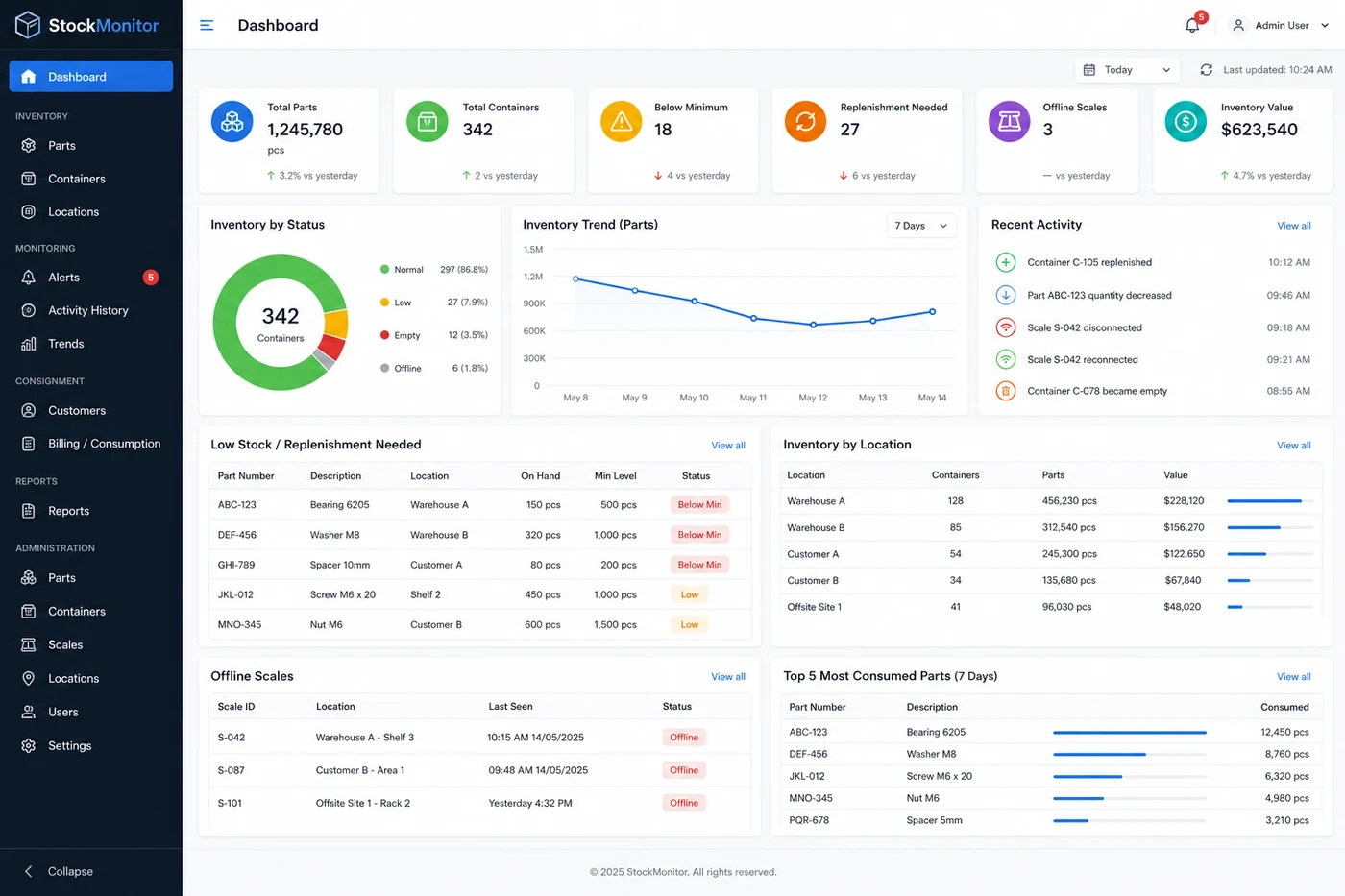
Dashboard showing all inventory always current

A perpetual inventory that is actually perpetual.

Every bin is counted every second. The stock record in your system matches the parts on the shelf — not approximately, not after the next count, but now.

What stocktakes actually cost.

People off the floor

A quarterly stocktake pulls two or more people off productive work for a full day. Four times a year, that is eight person-days spent counting parts that could be counted automatically.

Out of date immediately

The count is only accurate at the moment it is taken. By the time it is entered into the system, parts have already been taken and the record is stale again.

Errors compound

Manual counts have an error rate. Those errors carry forward into stock records, reorder calculations and financial reporting until the next count corrects them — or does not.

Replace the count with continuous measurement.

Always accurate

The scale reads the bin every second. The count in the system is the count on the shelf. There is no lag, no entry step, and no human error.

Full history

See the stock level at any point in time — when it was replenished, when it was drawn down, and how fast it was consumed. The audit trail writes itself.

Compliance-ready records

Continuous, timestamped inventory records support audit and compliance requirements without a separate stocktake exercise.

0
Stocktakes per year
0
Manual data entry
24/7
Accurate records
Full
Audit trail

Stop counting. Start knowing.

Tell us what you stocktake and we will show you how the system replaces it.